



A visit to Annecy’s Old Town is particularly enjoyable, as all the sights are clustered within a compact area. The terrain is flat, making it easy to get around for pushchairs and people with reduced mobility.
The historic centre of Annecy
The historic centre of Annecy, nicknamed the ‘Little Venice of the Alps’, began to develop in the 12th century. Before that, the inhabitants lived mainly on the hillsides of Annecy-le-Vieux and Gevrier. Thanks to the Thiou, a river running through the town, several craft trades were able to flourish. However, the houses were mainly made of wood, and the town suffered several devastating fires. In the 15th century, to limit this destruction, the Duke of Savoy ordered that houses should henceforth be built of stone.
Consequently, the architectural unity you can admire today in Annecy’s Old Town is the result of the many renovations carried out over the centuries by the buildings’ owners.
A city game to explore the town
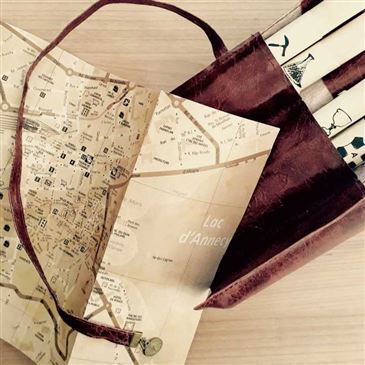
For a unique way to explore the Old Town, take part in a city game in the heart of Annecy. Work as a team to search for puzzles and clues scattered throughout the city’s streets to solve a mystery. This fun game lets you explore Annecy from a new perspective whilst taking on challenges. Several scenarios are available, and each session lasts around 2½ hours. The games run from Tuesday to Friday and on Sundays, from 10.00 to 18.00, for teams of 4 to 6 players.
The main sights of Annecy’s old town
Rue Sainte-Claire
No matter where you enter Annecy’s Old Town, you’ll find yourself immersed in a maze of picturesque alleyways lined with brightly coloured buildings – yellow, pink and green – dating back to the Middle Ages. Rue Sainte-Claire, the town’s main thoroughfare, is distinguished by its arcades dating from the 16th and 17th centuries, a true example of Renaissance urban planning. Today, these arcades are home to shaded restaurants, perfect for a break.
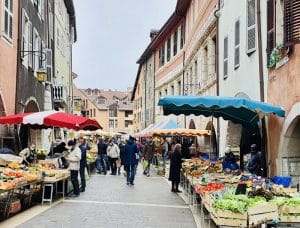
In the 15th century, following several devastating fires, the town was rebuilt. The old timber-framed houses gave way to stone buildings set back from the street, allowing pedestrians to pass through and traders to set up shop. The centre of the street was reserved for horse-drawn traffic. You’ll be able to appreciate the variety of façades, most of which have retained their medieval charm.
Crossing the River Thiou, you’ll arrive at Rue Jean-Jacques Rousseau, where Saint-Pierre Cathedral stands. It was here that the writer learnt music and met Madame de Warrens. The Balustre d’Or fountain, located at number 10 on the street, bears witness to this historical past.
Perpendicular alleyways will lead you to Annecy Castle. Be warned, however, that the climb up to it is quite steep. If you’d prefer to avoid the slope, you can park at the Château public car park, situated just 200 metres from the flat road.
The Perrière and Saint-Claire Gates
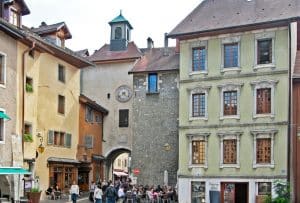
If you continue to the end of Rue Saint-Claire, you’ll come across the Perrière Gate, followed by the Saint-Claire Gate, which mark the boundary of the Old Town. These ancient fortified gates are a reminder of the days when residents had to pay a toll to enter the town, offering a glimpse into Annecy’s medieval history.
The Old Prisons or the Palais de l’Isle
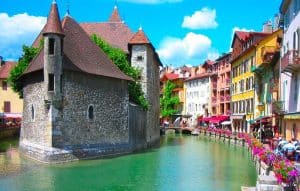
The Pont Perrière offers an unmissable view of the famous Old Prisons, also known as the Palais de l’Isle, an iconic symbol of Annecy. Formerly a prison, a chancellery and a courthouse, this monument is now open to the public as a museum.
Following the River Thiou, you’ll reach the Jardin de l’Europe, a wooded park where you can enjoy the view of the Île des Cygnes. After exploring the gardens, cross the Pont des Amours, which spans the Canal du Vassé, to reach the Pâquier, a vast, leafy park, ideal for relaxing and admiring the beauty of the lake and the surrounding mountains.
The Thiou, a small river running through the Old Town
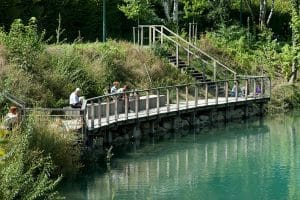
The Thiou, which rises in the Canal du Vassé, has developed banks stretching for several kilometres, offering a pleasant walk from Annecy to Cran-Gevrier. This canal, once vital to the town’s trade and economy, now plays an important role in regulating the water level of Lake Annecy via a system of sluice gates.
To find out more about the history and current use of Annecy’s canals, read our detailed article.
The difference between Old Annecy and Annecy-le-Vieux
 Many visitors wish to explore Annecy’s Old Town and instinctively follow the signs for Annecy-le-Vieux. However, to explore the historic heart of Annecy, you should head for the Old Town, where you can stroll through its pedestrianised streets and admire its canals. If you follow the signs for Annecy-le-Vieux, you’ll arrive in a neighbouring district bordering the city centre. This neighbourhood owes its name to the Gallo-Roman era, when this sunny region was dedicated to wine-growing.


