



In our mountains, it is possible to observe many types of flowers, emblematic of the Alps. But would you be able to recognize them on hiking trails? We present them to you and help you find your way.
Mountain flowers, generalities
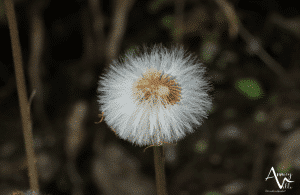 The flowers of our mountains are numerous and adapt very well to climatic variations, which can sometimes be significant. Several reasons explain this. The mode of vegetative reproduction, for example, helps to counterbalance shortened seasons.
The bright color of the flowers also promotes pollination, which offers better resistance to UV rays. You may have noticed that mountain flowers are generally not very large. This allows them to reduce their exposure to the wind.
A flora that varies according to vegetation levels
The flora evolves according to altitude. It will not be the same, for example, in Annecy and at Grand-Bornand. Vegetation is distributed according to a succession of levels whose limits vary depending on exposure, in particular. In local jargon, the terms Adret and Ubac are used to refer to the sunny and shady sides of a mountain.
As for the levels, they are composed as follows:
-
The collinean level. It extends up to 800 meters in altitude. This is where deciduous forests form.
-
The mountain level. It ranges between 800 and 1,500 meters and is occupied by conifers, beeches, and meadows.
- The subalpine level, from 1,500 meters to 2,200 meters. It constitutes the upper limit of forests. Small shrubs develop there.
-
The alpine level. This level, which extends up to 3,000 meters in altitude, gives way to alpine lawns and rocks on which special vegetation grows.
-
The nival level. Plants are rare here, as the altitudes are the highest.
The protection of flora
Today, mountain flora is protected. Structures are established at the national level, such as National Parks, at the regional level with Regional Natural Parks, and at the local level with Nature Reserves like that of the Aiguilles Rouges in Chamonix. In France, it is thus prohibited to pick nearly 500 plants, such as the martagon lily or edelweiss.
The emblematic flowers of Haute-Savoie
Among all the flowers and plants present in Haute-Savoie and Savoie, some are more emblematic than others. We invite you to discover the main ones.
The edelweiss
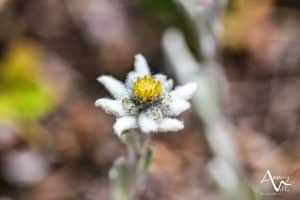
The edelweiss, leontopodium alpinum, is also known as the silver star or lion’s foot. It is probably the most emblematic flower of our mountains. Today, the edelweiss is protected in France, although it is allowed to pick it in the amount that fits in an adult’s hand.
The star of glaciers is not always easy to find, as it only grows between 2,000 and 3,000 meters in altitude. So you will need to keep your eyes open if you want to have a chance to spot it on hiking trails.
The blue gentian
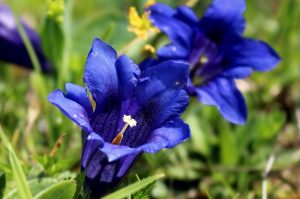 The blue gentian, gentiana lutea, is less known than its yellow counterpart. However, it is not uncommon to encounter it in our mountains, between 1,000 and 2,000 meters in altitude. Picking this perennial plant is prohibited. The height of the blue gentian varies between 10 and 90 centimeters, depending on the varieties and its location.
The fireweed
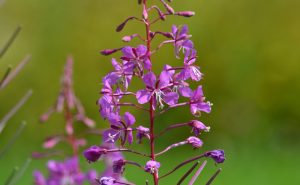
The fireweed, epilobium angustifolium. This name may not mean much to you, yet you have surely encountered it along a mountain path. These herbaceous plants have pink flowers and usually grow in groups.
The old say that their height is a way to know whether there will be, or not, snow the following winter. Note that this wildflower is edible.
The mountain centaury
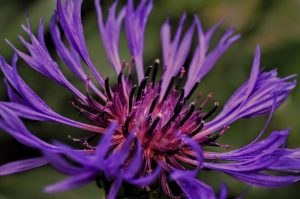
The mountain centaury, centaurea montana, is a perennial plant that blooms between April and August in our Haute-Savoie mountains. The flowers can have several colors, from white to yellow, passing through purple and pink. You will find it up to the subalpine level, in rather sunny areas.
The cotton grass
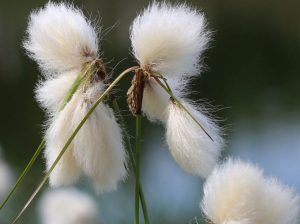
The cotton grass, eriophorum angustifolium, is also known as the cotton rush. Visible at the end of summer and the beginning of autumn, near mountain lakes and marshes, it helps to naturally stabilize the banks.
When it reaches maturity, a kind of cottony fluff covers it. The cotton grass is particularly robust and resistant to cold. It needs sunlight and nutrient-rich soil to thrive.
The lady’s slipper
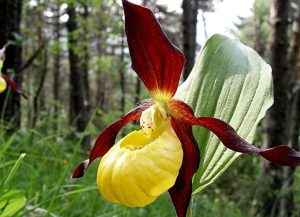
The lady’s slipper, paphiopedilum, is a species of orchid with persistent foliage. Today, it can be found in certain mountainous areas such as the Bauges or the Aravis, although this remains rare.
The lady’s slipper is a protected plant characterized by its bright yellow, slipper-shaped lip. Its flowering period lasts for a month, from late May to late June. It grows in the clearest meadows or forests.
Medicinal flowers and plants present in Haute-Savoie
Flowers are often used in self-medication. They indeed have medicinal properties, which are specific to each plant. Here are some examples.
The arnica
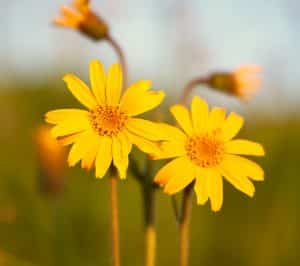
Arnica, arnica montana, is a flower found in alpine meadows. You will normally see it without difficulty during the summer season.
Arnica is used in the preparation of ointments for treating various minor traumas. You can also consume it in the form of homeopathic pellets.
Our tip: use arnica in shower gel after a workout. Recovery will be improved and faster.
The yellow gentian
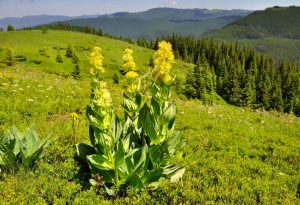
The yellow gentian, gentiana lutea, is not only used to make liqueur. It also has medicinal virtues, particularly for digestion, and helps combat gastric pain. In case of infection, it has a fever-reducing action.
The yellow gentian is generally found between 800 and 1,500 meters in altitude. Its stem can reach up to 1.5 meters in height. Flowering occurs between June and July.
The violet
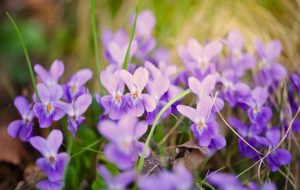
The violet, viola cenisia, is distinguished from the alpine pansy by the arrangement of its petals. This small bushy plant is known for its medicinal properties. It is thus expectorant and helps calm coughs. The ideal way to consume it is in the form of infusion.
The violet also helps to calm stress, in addition to being effective against indigestion. Some even use it in the form of a warm poultice to more quickly heal small wounds or cracks.
The purple foxglove
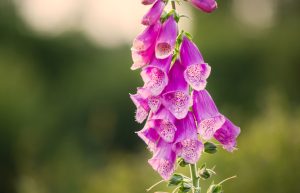
The purple foxglove, digitalis purpurea, is also called wolf’s tail. It is found in forests, in the shade.
The purple foxglove is known for its toxicity, so it should not be consumed like we would eat blueberries. However, it can also be used due to its medicinal properties. It contains substances in its leaves that are used to regulate heart function.
Which mountain flowers for cooking?
Some plants and flowers found in the mountains of Savoie and Haute-Savoie can be used in cooking. It is not uncommon for restaurateurs to use them in their dishes. Focus on the most well-known.
The génépi
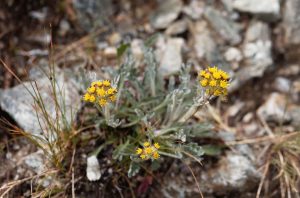
The génépi, artemisia absinthium, actually has four subspecies. While génépi is often used to make liqueur, it can also be used to flavor cheeses, sausages, or even beer.
Additional info: the picking of génépi is regulated and should be limited to family picking. So be sure to inquire before heading out to search for this plant. And if you decide to give it a try, be careful not to uproot the entire plant.
The blueberries
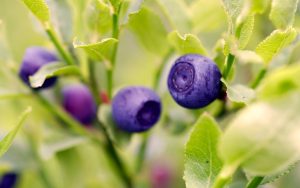
Blueberry bushes, vaccinium myrtillus, are the source of blueberries, these wild fruits highly appreciated in cooking. Depending on sun exposure and altitude, harvesting takes place between July and September.
Blueberries have many virtues. They are particularly anti-inflammatory and rich in vitamins. In cooking, you can obviously make good pies, but also opt for jam or a gazpacho made from red fruits.
Our tip: we recommend picking blueberries with a comb designed specifically for this purpose. This way, you will spend less time on the same plant.
The wild garlic
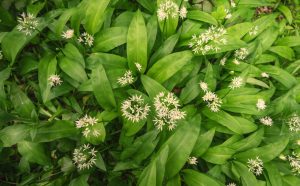
Wild garlic, allium ursinum, is a plant found in cool, damp undergrowth. It can be found around Annecy without having to go too far.
According to legend, bears used this garlic to purge themselves at the end of winter. On our side, we have been using it since the Neolithic. In addition to having a high vitamin C content, wild garlic is often used in cooking. We find it in cheese, soups, and also in the form of pesto.
The juniper berries
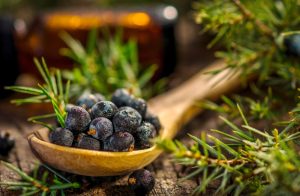 The juniper, juniperus communis, produces small, very tasty berries. They are generally used as condiments in dishes. They also have digestive and antiseptic virtues. Juniper berries can be harvested throughout the year.
Our tip: to simplify harvesting, use a cloth. Place it under the branch and shake it. The berries will fall directly into it.
The rose hip
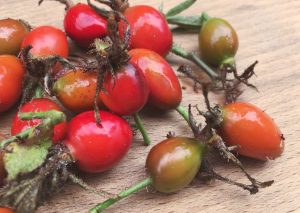
The rose hip, rosa canina, is known by several names: wild rose or even “butt scratcher” in local jargon. Very present up to 1,700 meters in altitude, the rose hip is harvested in winter.
Very rich in vitamin C, the berries can be consumed in the form of herbal tea, jam, or even sauces.
Our tip: whether you consume the berry cooked or raw, remember to remove the black head present at its end.
Toxic plants and shrubs for our animals
It should also be noted that some plants and shrubs in our mountains are toxic to animals, such as dogs or horses. Here are a few of them.
The bracken
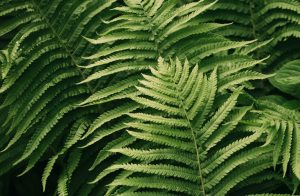
The bracken, pteridium aquilinum, is present in many forests of Haute-Savoie and Savoie. You can see it in the Semnoz or even in the Aravis.
It is the rhizomes that are the most toxic, particularly for equines. Consuming bracken can become fatal from 80 grams. It causes severe diarrhea, as well as colic and congestion of the kidneys or lungs.
The belladonna
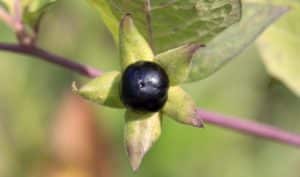
The belladonna, atropa belladonna, is a perennial herbaceous plant whose stems can reach up to 1.5 meters in height.
Toxic, this flower paralyzes the nervous system, causing an increased heart rate and dilation of the pupils. The berries are the most toxic part of the belladonna. Therefore, neither you nor your animals should consume them.
The colchicum
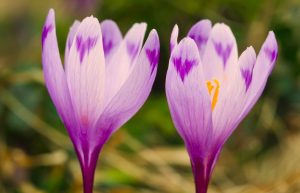
The autumn colchicum, colchicum autumnale, contains colchicine. This substance could be compared to arsenic and causes respiratory paralysis. Animals are particularly sensitive to it, such as horses. Thus, a poisoned foal generally has only 48 hours to live. It is better to be cautious.
The rhododendron
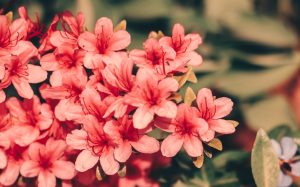
The rhododendron, better known as rhodo, is toxic to animals.
In dogs, just one or two leaves can cause colic or severe vomiting. In high doses, rhodo can cause paralysis or seizures.
Is picking wild plants risky?
Picking wild plants is not without risk, especially if you plan to consume them later. Some precautionary principles can therefore be applied:
-
Like mushrooms, do not pick flowers if you are not sure of their origin.
- Soak the flowers in vinegar for at least 15 minutes.
- Cook the plants and flowers to avoid any risk of contamination.
Since flowers grow in natural environments, it is not impossible that they may at some point come into contact with wild animals or those affected by certain diseases.
The fox disease
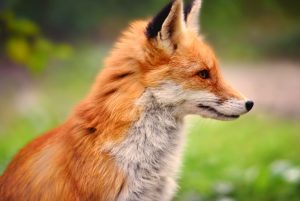 The fox disease, echinococcosis, is one of the most serious diseases that can be transmitted to humans. This parasitic disease can be transmitted by foxes, wolves, but also dogs that have eaten an infected rodent.
The fox disease can be fatal, and an average of 30 cases are reported each year in France. Haute-Savoie is particularly affected by this disease. Therefore, do not consume flowers collected during your hikes without soaking them in vinegar first.
The liver fluke
Another risk when picking flowers is the liver fluke. This disease is particularly widespread among cattle and sheep. Transmitted to humans, it can cause liver cirrhosis. To avoid any contamination, we recommend not consuming flowers or plants that have been picked near pastures.


